

How bright are our city streets at night, and what is the color quality of the artificial light surrounding us? Between 16 September and 22 October 2026, 16 dedicated citizen volunteers took to the streets of Zaragoza and its surrounding area (up to 30 km) equipped with handheld, GPS-enabled lux meters lent by our project.
Walking across 26 different nights, these participants logged a total of 19,062 geolocated measurements across 87 routes, covering a combined distance of 253 km. The gathered data provides a detailed, street-level snapshot of ground illuminance and light color temperature across the municipality, with all readings openly accessible on the OpenRed map platform.
Key Findings at a Glance
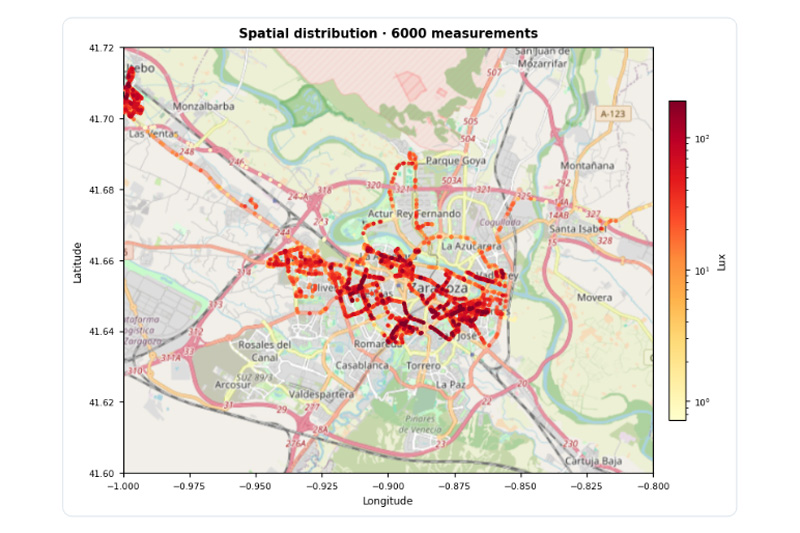
Filtering out residual daylight to analyze 18,920 strict nighttime readings (taken after civil twilight with the sun below −6°), the campaign yielded the following interim statistics:
- Total Measurements Recorded: 19,062 points.
- Median Ground Illuminance: 17.0 lux.
- Median Color Temperature (CCT): 2,458 K.
- Over-Illuminated Areas (> 30 lux): 29% of all night readings.
- Warm Lighting (≤ 3,000 K): 70% of all night readings.
Ground Illuminance: How Bright is Zaragoza at Night?
The campaign revealed a median ground illuminance of 17.0 lux, with half of all recorded readings falling between 7.8 and 33.4 lux.
The full distribution of nighttime illuminance shows:
- < 2 lux: 6.6%
- 2 – 5 lux: 9.5%
- 5 – 10 lux: 15.7%
- 10 – 15 lux: 13.7%
- 15 – 30 lux: 26.0%
- > 30 lux: 28.6%
For comparison, European pedestrian lighting standards (EN 13201-2) and Spanish regulations (RD 1890/2008) generally recommend an average illuminance between 2 and 15 lux for pedestrian streets, depending on traffic conditions. The fact that 29% of all readings exceed 30 lux indicates significant areas of local over-illumination across urban corridors.
Light Spectrum: A Predominance of Warm Light
Beyond brightness, the color spectrum of artificial light plays a crucial role in ecological disruption, as cold, blue-rich light is particularly harmful to nocturnal wildlife and human circadian health.
In Zaragoza, the median Correlated Color Temperature (CCT) was measured at 2,458 K. The breakdown across color temperature ranges shows:
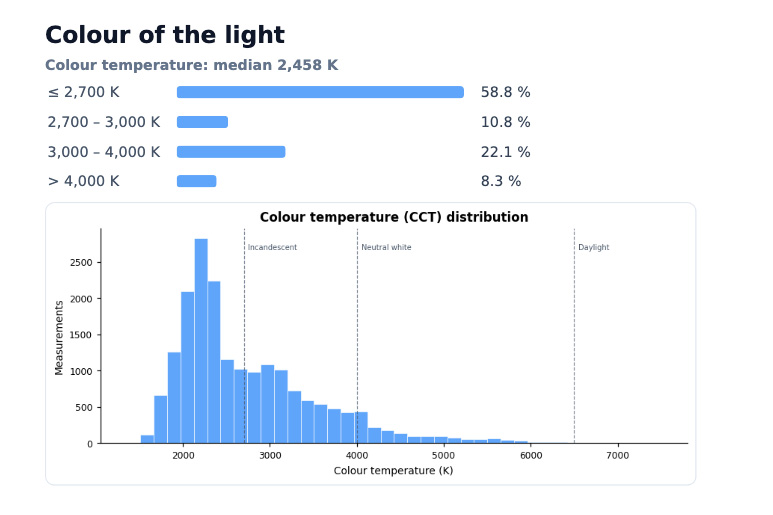
DarkSky International recommends that outdoor lighting should not exceed 3,000 K, a threshold also adopted into national law in countries like France for urban spaces. In Zaragoza, 70% of readings are below 3,000 K, demonstrating a high prevalence of warmer, amber-toned lighting that is significantly less damaging to nocturnal ecosystems than cool-white LEDs.
Spatial Distribution: District & Distance Variations
Light levels vary considerably across urban zones and distance from the city core:
- City Centre (up to 2 km): Recorded a median of 19.6 lux (2,557 K), with 34% of readings exceeding 30 lux.
- Mid-City (2 – 6 km): Recorded a median of 15.3 lux (2,328 K), with 22% exceeding 30 lux.
- Outskirts (over 6 km): Recorded a median of 13.2 lux (2,819 K), with 24% exceeding 30 lux.
Among municipal districts with at least 100 night readings, Universidad registered the highest median illuminance at 28.5 lux (47% > 30 lux), followed by Las Fuentes (23.2 lux) and Centro (22.7 lux). In contrast, rural and outlying districts like Venta del Olivar (4.6 lux) and Garrapinillos (0.1 lux) preserved much darker nightscapes.
Comparing Zaragoza’s urban core against other cities in the OpenRed database shows that while Zaragoza’s city centre has slightly higher median ground illuminance (18.2 lux vs. 13.2 lux elsewhere), its light spectrum is notably warmer (2,447 K vs. 3,114 K elsewhere).
Citizen Science, Open Science and Next Steps
Because this monitoring campaign remains open, these interim findings provide a strong baseline for ongoing analysis. All individual measurements are published as open data on map.open-red.es, an initiative powered by Ibercivis as part of the PLAN-B project.
This ground-level dataset directly supports PLAN-B’s broader mission to combine citizen observations, satellite imagery, and ecological modeling to protect nocturnal biodiversity across Europe.