
We live on a planet that is brighter and louder than ever before. While artificial light at night (ALAN) and anthropogenic noise have enabled modern human society, they have also fundamentally altered the natural sensory environment that wildlife evolved to rely on for millions of years.
Despite over a century of scattered studies, sensory pollution has historically been overlooked in environmental regulations and conservation planning. To bridge this gap, the PLAN-B project has published its foundational report: Deliverable 1.1 (D1.1) – Review of Light and Noise Pollution Impacts on Terrestrial Biodiversity and Ecosystem Services.
Led by researchers across the PLAN-B consortium, this landmark deliverable synthesizes thousands of scientific publications to answer critical questions: How do light and noise affect different animal groups? What happens when both stressors occur together? And how do these disruptions impact the natural services that ecosystems provide to humanity?
Key Scientific Takeaways from D1.1
1. The “Double Jeopardy” of Combined Pressures
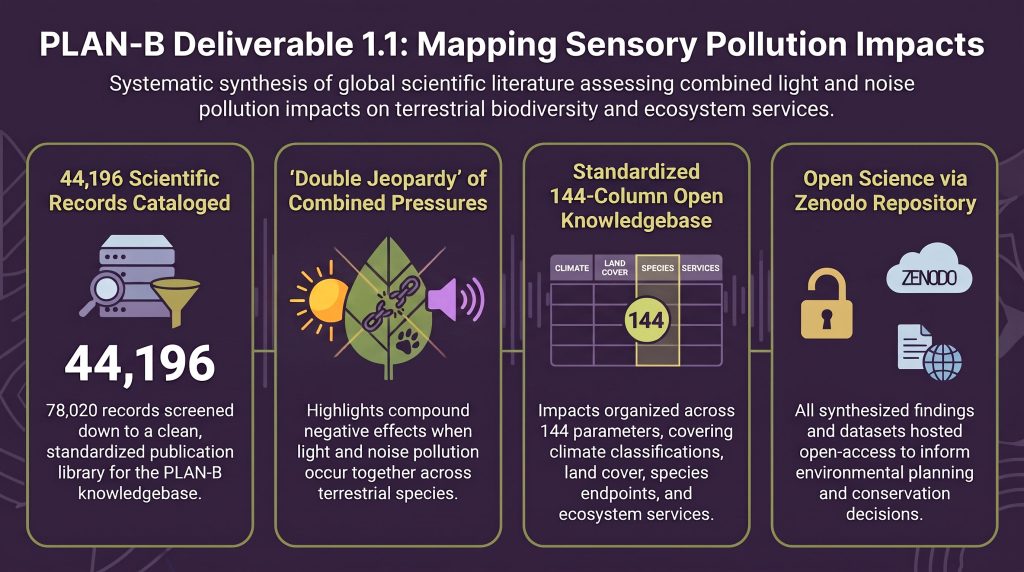
In urban, industrial, and transportation corridors, light and noise pollution rarely occur in isolation. D1.1 highlights that when organisms are exposed to both light and noise simultaneously, the combined effect can be additive or even synergistic—meaning the negative impact is far greater than the sum of each stressor individually. From altering bird song and amphibian communication to reducing overall species abundance, multi-sensory pollution creates a compounded challenge for wildlife.
2. One Size Does Not Fit All: Beyond Human Metrics
A major conclusion of D1.1 is that traditional environmental metrics—such as decibels weighted for human hearing (dB A) or light brightness measured in Lux—fail to capture how animals actually experience their surroundings.
- Visual Sensitivities: Different taxa (from moths and beetles to amphibians, birds, and mammals) have photopigment sensitivities tuned to specific light wavelengths. Even dim, blue-rich LED lighting can severely disorient species or alter circadian rhythms.
- Acoustic Masking: Animals communicate, navigate, and detect predators using frequencies well outside human hearing ranges. Standard human-centered noise maps miss these species-specific disturbances.
3. Cascading Effects on Ecosystem Services
When individual animals change their behavior, the consequences ripple across entire ecosystems. D1.1 outlines how sensory pollution threatens vital ecosystem services:
- Nocturnal Pollination: Artificial light attracts and disorients moths and nocturnal insects, reducing flower visitation rates and impairing plant reproduction.
- Natural Pest Control: Light-shy predators like bats avoid brightly lit corridors, reducing their ability to control agricultural insect pests.
- Soil Health & Seed Dispersal: Noise drives away seed-dispersing birds and small mammals, while artificial light alters litter invertebrate activity, impacting natural decomposition and soil fertility.
- Cultural Value: Skyglow and pervasive noise degrade dark skies and natural soundscapes, eroding our cultural connection to undisturbed nature.
4. Cutting-Edge AI for Open Science
Processing tens of thousands of scientific papers is an immense task. To build an open-access knowledgebase efficiently, the PLAN-B team developed a custom Artificial Intelligence workflow using the open-access Gemma model. This AI-assisted pipeline automated data extraction across 40,000+ scientific records with high accuracy, allowing researchers to rapidly turn raw literature into structured, actionable evidence for policymakers.
Open Access: Explore D1.1 on Zenodo
In line with our commitment to Open Science and European research transparency, the full Deliverable 1.1 report, its underlying evidence structures, and related policy briefs are publicly archived and freely accessible in the Environmental Impacts of Light & Noise Pollution Zenodo Community.
Zenodo serves as PLAN-B’s official open-access repository, ensuring that scientists, urban planners, lighting engineers, and conservationists worldwide can download, cite, and reuse our findings to support evidence-based environmental decision-making.
Read and download Deliverable 1.1 on Zenodo (or explore the broader PLAN-B Zenodo Community Collection for all project outputs!)
Help us spread the word! Follow our progress on social media, share this article with your network, and subscribe to the PLAN-B Newsletter to stay updated on our upcoming mapping tools, policy briefs, and citizen science activities!