
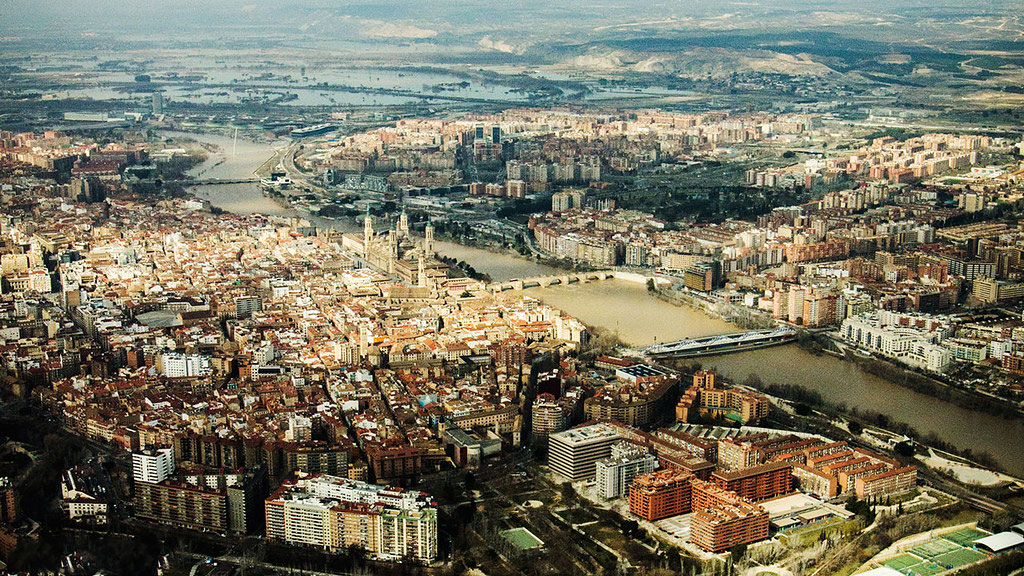
On October 8, 2026, the European Commission officially designated Zaragoza as European Green Capital 2028 at an awards ceremony held in Guimarães, Portugal. Selected ahead of fellow European finalists Oporto, Aalborg, Bielsko-Biała, and Košice, Zaragoza earned top honors for its comprehensive urban sustainability strategy, strong environmental governance, and exemplary citizen engagement.
As part of the PLAN-B project (Horizon Europe), Zaragoza serves as one of four key European and international pilot regions (alongside Leipzig, Gdańsk, and Belo Horizonte) where researchers, municipal managers, and local citizens collaborate to address sensory pollution. PLAN-B’s ground-level research and citizen science campaigns directly support Zaragoza’s mission to build a quieter, darker, and ecologically resilient urban environment.
Zaragoza as a Living Lab for PLAN-B
To evaluate urban environmental quality, the European Green Capital jury assesses seven core indicators, including noise pollution, biodiversity and green spaces, climate adaptation, and civic participation. In Zaragoza, the municipal government has set explicit targets to reduce noise-exposed populations by at least 20% by 2030—with a clear focus on nighttime quietness—while eliminating 100% of emissions from public street lighting.
PLAN-B’s pilot activities in Zaragoza provide the granular, scientific data needed to turn these strategic ambitions into measurable urban policy:
- Establishing a Community of Practice (CoP): Coordinated by the Ibercivis Foundation, PLAN-B assembled a local quadruple-helix network bringing together municipal authorities, researchers, local businesses, environmental NGOs, and citizens to co-design solutions for sensory pollution.
- Street-Level Light Pollution Mapping: Between September and October 2026, 16 local citizen volunteers equipped with handheld GPS lux meters mapped nocturnal illuminance across 87 urban routes, recording 19,062 geolocated measurements over 253 km.
- Open Science & Transparent Data: All measurements gathered during the Zaragoza campaign are published open-access on the OpenRed platform (
map.open-red.es), offering urban planners an unprecedented street-by-street baseline of nocturnal illumination.
Key Data Insights for Urban Biodiversity & Lighting Management
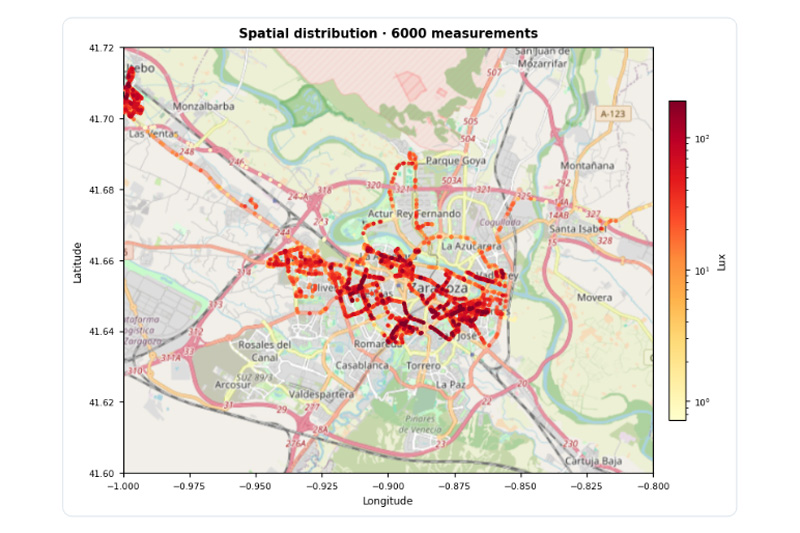
Interim findings from PLAN-B’s Zaragoza monitoring campaign reveal critical insights for municipal lighting management:
- Illuminance Levels: The median ground illuminance across nighttime readings stood at 17.0 lux. While peripheral and rural districts like Garrapinillos (0.1 lux) and Venta del Olivar (4.6 lux) maintain dark nightscapes, 29% of central urban readings exceeded 30 lux, pinpointing specific corridors where over-illumination can be reduced to save energy and protect nocturnal fauna.
- Spectral Quality: The median Correlated Color Temperature (CCT) in Zaragoza was measured at 2,458 K, with 70% of readings below 3,000 K. This high prevalence of warm, amber-toned LED lighting is significantly less harmful to insects, bats, and human circadian rhythms than cool, blue-rich light.
- Urban vs. Rural Gradients: Ground illuminance decreased from a median of 19.6 lux in the city center down to 13.2 lux in outer districts, providing baseline metrics to guide the creation of dark corridors connecting urban green spaces with surrounding protected areas.
Citizen Empowerment: The Core of Green Governance
A defining factor in Zaragoza’s European Green Capital victory was its emphasis on public involvement and co-governance. PLAN-B mirrors this approach by putting monitoring tools directly into the hands of residents. From street walks with handheld sensors to classroom workshops and satellite image georeferencing via the Lost at Night app (lostatnight.org), local citizens are actively shaping their city’s environmental policy.
By integrating citizen science datasets with ecological models and policy recommendations, PLAN-B is helping Zaragoza demonstrate how European cities can combine vibrant urban life with nature conservation.
Looking Ahead to 2028
As Zaragoza prepares to assume its role as European Green Capital 2028, PLAN-B will continue to expand its local activities—refining environmental noise models, testing biodiversity-sensitive lighting controls, and sharing lessons learned with cities across Europe.
🔗 Explore the Data: View Zaragoza’s open-access light pollution map on map.open-red.es and discover more about the project at plan-b-project.eu.