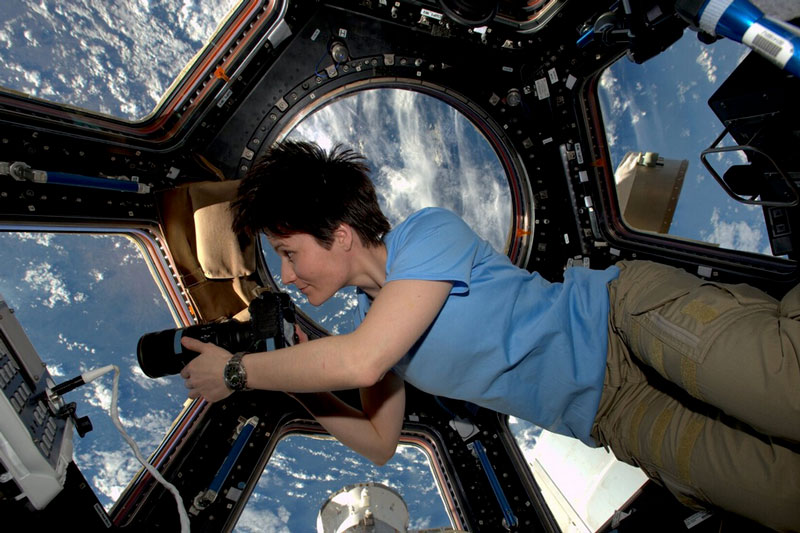
On 21 May at 12:00h (CET), PLAN-B will be hosting an online workshop of Lost at Night, the citizen science tool that enables the georeferencing of night-time images of Earth captured by astronauts aboard the International Space Station (ISS). This workshop will feature two scientific presentations and a practical workshop open to anyone wishing to take part.
Practical information
- Date and time: 21 May 2026, from12:00h to 13:30h (CET)
- Registration: Free and compulsory. Link to registration.
- Format: Online
- Language: English
- More information about the tool at lostatnight.org.
Provisional programme
- 12:00 – 12:05h Opening. Welcome and project context: the role of citizen science in night-time research, and the Cities at Night and PLAN-B (Horizon Europe) projects.
- 12_05 – 12:15 Scientific presentation. Alejandro Sánchez de Miguel (scientific team). Alejandro will present what can be gleaned from the ISS’s night-time images, what makes them an irreplaceable data source, and why the human eye remains essential for georeferencing them.
- 12:15 – 12:25h Technical presentation. Francisco Sanz (Ibercivis, development). Francisco will present how Lost at Night works: the workflow from an image without coordinates to a validated control point, and how citizen contributions are integrated into the scientific dataset.
- 12:25 – 13:15h Hands-on workshop. A guided session in which participants will work with the tool in real time. Group objective: to add 3000 control points between all participants.
- 13:15 – 13:30h Closing session. Summary of the session’s results, next steps for the project and ways to continue collaborating.
The collective aim of the workshop is for all participants to add 3,000 waypoints during the workshop.
Who is it for

The session is open to anyone interested, including but not limited to the scientific community, space and research project managers, teaching staff, students, science communicators, astronomy societies, and the general public. No prior technical knowledge is required.
What information do night-time images from the ISS contain? The importance of Lost At Night
Once georeferenced, the night-time photographs taken from the ISS inform research in a wide range of fields:
- Biodiversity and ecosystems. Artificial night-time light disorients migratory birds, interferes with the reproduction of pollinating insects, alters predator-prey relationships and draws sea turtle hatchlings ashore. Mitigating the effects of light and noise pollution on European ecosystems is the aim of the European PLAN-B project, in which Ibercivis participates and of which Lost At Night is an important part.
- Human health. Certain spectra of night-time light are associated with sleep disturbances and disruptions to circadian rhythms.
- Energy efficiency. The images enable the identification of the predominant types of lighting (LED, sodium, halide) and the assessment of the impact of public lighting policies.
- Economy and development. Night-time lights are a recognised indicator of economic activity, urbanisation and electrification. Institutions such as the IMF and the World Bank use them to estimate regional GDP, particularly where official statistics are scarce.