

Anthropogenic noise pollution is a growing threat to terrestrial ecosystems, but how do animals actually perceive sound? To address this critical question, researchers from the European PLAN-B project participated in Forum Acusticum 2026, held from September 8 to 11 in Graz, Austria.
During the conference, the PLAN-B team presented three key scientific contributions focused on evaluating species-specific hearing sensitivities, a crucial factor in designing truly effective noise mitigation measures for biodiversity conservation.
1. Species-Aware Road Traffic Noise Mitigation
In the presentation “Towards biodiversity-aware road traffic noise mitigation measures”, researchers evaluated how conventional noise control measures—such as noise barriers, earth berms, depressed roads, speed reductions, and heavy vehicle bans—vary in effectiveness depending on the target species.
This variation stems from two main factors: differences in hearing sensitivity across frequencies and the elevation of wildlife habitats relative to the ground. For instance, calculations show that to prevent interference with a songbird perched 5 meters high in a tree, earth berms and depressed roads remain highly effective even a couple of hundred meters away. In contrast, measures like speed reductions or truck bans offer significantly more limited benefits for canopy-dwelling species.
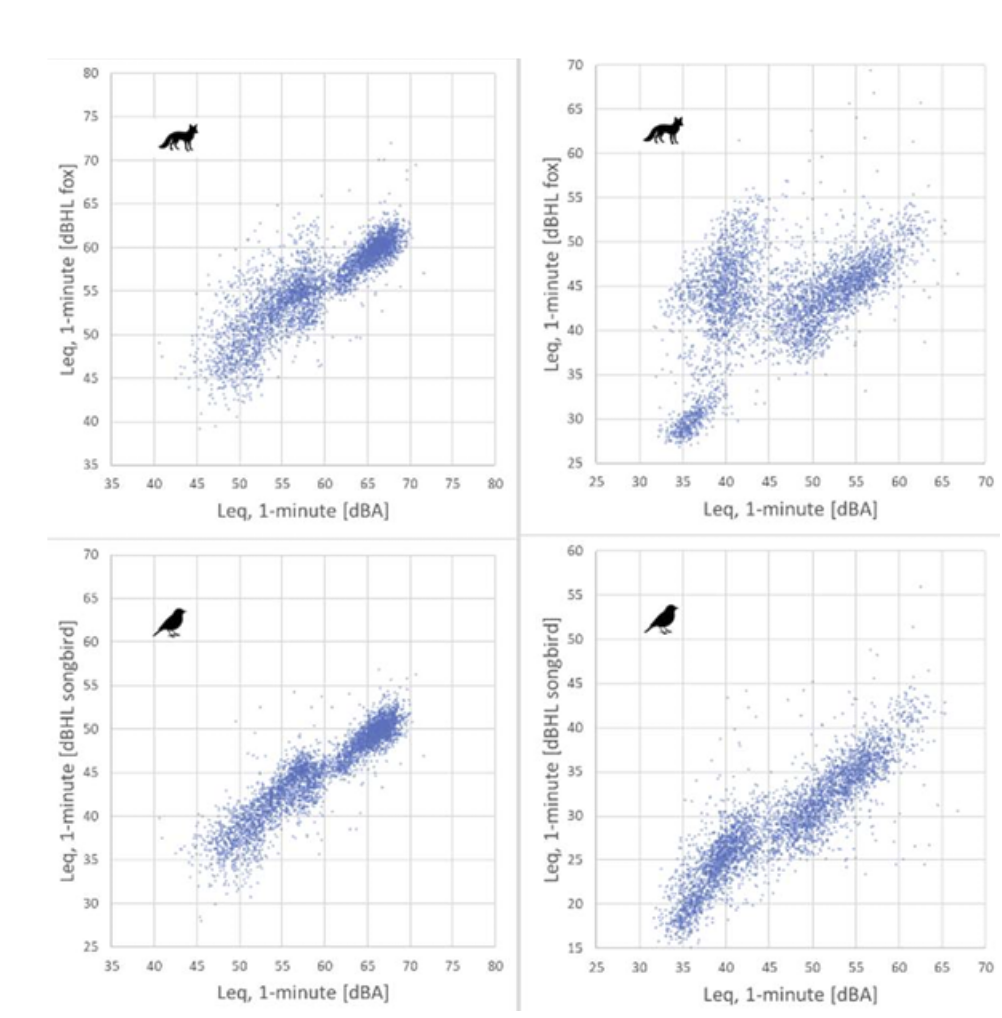
2. Assessing the Impact of Outdoor Music Festivals
The second study, titled “Assessing the impact of outdoor music festivals on biodiversity”, investigated the temporary acoustic pressure generated by large outdoor music events adjacent to natural areas.
Based on 24-hour continuous measurements over 3 days near a music festival in Belgium, the researchers demonstrated that human-centric A-weighted noise levels do not accurately capture wildlife impacts. Species with distinct hearing profiles, such as the red fox, perceive and react to sound frequency spectrums and acoustic pressure levels very differently than humans or birds do.
3. AI and Machine Listening to Decouple Soundscapes
A major challenge in environmental acoustic monitoring is that field microphones capture biological animal calls and loud anthropogenic disturbances simultaneously.
In the presentation “Disentangling Animal Vocalisations and Anthropogenic Sound to Assess Noise Effects on Biodiversity”, the PLAN-B team introduced an innovative solution based on AI and machine listening. This algorithm successfully decouples and separates animal vocalizations from disturbing background noise, allowing passive acoustic monitoring to serve a dual purpose: measuring ambient noise levels while tracking animal presence and distribution in real time.
Advancing Science-Informed Environmental Policy
The findings presented in Graz highlight the urgent need for environmental protection strategies to look beyond traditional human noise standards. By integrating species-specific spectral and spatial sensitivities into ecological models, PLAN-B continues to develop robust scientific tools and regulatory recommendations for quieter, more sustainable soundscapes across Europe.
📢 Interested in following our latest research and mitigation tools? Subscribe to the PLAN-B Newsletter or explore our recent publications in the project’s research section 🌌🦉.